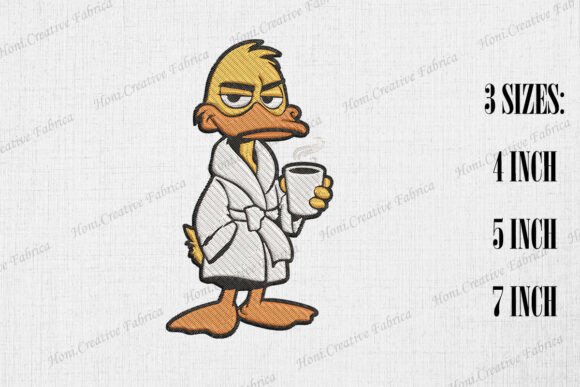
Grumpy Duck in Bathrobe
A Design That Winks Before It Stitches
First impression? This isn’t just another bird motif—it’s a personality with posture. Grumpy Duck in Bathrobe lands somewhere between dry wit and cozy rebellion: a plump, slightly rumpled duck wrapped in a loosely tied robe, beak tilted downward like it’s already judged your life choices. The silhouette is bold but not oversized—clean lines, intentional negative space around the robe’s lapel and webbed feet, and just enough detail (a single button, subtle feather texture on the head) to read clearly at 3–4 inches tall. It doesn’t scream. It sighs—and that makes it unusually versatile for real-world embroidery projects.
Where It Shines: Real Projects, Not Just Mockups
I recently tested Grumpy Duck in Bathrobe on a heavyweight organic cotton tote bag for a local café’s staff gift set. No frills—just black thread on natural canvas, medium-weight cutaway stabilizer. It stitched cleanly in one pass, held its shape across the bag’s curved side seam, and landed exactly where intended: friendly but not cutesy, memorable but not loud. That’s the sweet spot.
- Sweatshirt embroidery: Works beautifully on midweight fleece or French terry—no distortion, no puckering. The robe’s drape reads even at reduced scale.
- Baby embroidery: On a soft interlock onesie, it reads as gentle humor—not sarcasm. Paired with light gray or oatmeal thread, it feels warm and handmade, not ironic.
- Embroidered patch: Clean edges and minimal satin stitch transitions make it ideal for iron-on or sew-on patches. Holds up well after washing and gentle tumble drying.
- Kitchen towel & apron design: The bathrobe theme clicks instantly in food-adjacent spaces—especially when paired with coffee or pancake motifs in a small-batch boutique collection.
- Holiday embroidery: Surprisingly effective for “anti-Christmas” or cozy winter gifting—think embroidered on flannel pillow covers or knit caps for a craft fair stall.
Where to Pause—and Plan Ahead
This isn’t a “set and forget” file. Its charm lives in contrast and clarity—and those require intention.
On thin fabric (like lightweight rayon or baby rib knit), use tear-away + light cutaway stabilizer. Without it, the fill stitch in the robe’s body can pull slightly, softening the duck’s signature scowl. On stretchy fabric, especially for t-shirts or fitted baby bodysuits, baste first and check hoop tension—this design doesn’t forgive uneven stretching.
The robe’s lapel and the duck’s eye are small but critical details. If you’re stitching below 2.5 inches wide—or using dense thread colors on dark fabric—verify those elements hold up in your test run. I’ve seen the eye vanish into navy thread on black terry cloth unless the stitch density is dialed back slightly (check your machine’s density adjustment or consult the file’s documentation).
For curved surfaces like structured caps or baseball hats, avoid placing Grumpy Duck in Bathrobe too close to the bill seam. Its horizontal emphasis works best on flat or gently rounded areas—not steep crowns.
What It Does for Your Craft Business
As an Etsy seller and small shop owner, I pay attention to how a design affects perceived value—and Grumpy Duck in Bathrobe lifts it. Customers don’t buy “a duck.” They buy a story: comfort, quiet defiance, morning authenticity. That translates directly to higher engagement on product listings, better photo mockup performance (it reads clearly in natural light), and stronger repeat interest—especially among buyers who curate their wardrobes or home goods with intention.
It also supports brand consistency without demanding uniformity. Use it across baby onesies, linen tea towels, and unisex sweatshirts—and it still feels like part of the same thoughtful line. That cohesion matters when you’re building a recognizable handmade product identity.
And yes—it’s gift-ready. Not in a generic “happy birthday” way, but in the way people remember who gave them something that made them pause and smile while folding laundry.
Designer Notes You’ll Actually Use
- Always test first—on scrap fabric matching your final project’s weight and stretch.
- Check thread color contrast before stitching on dark or textured backgrounds. A charcoal duck on charcoal terry won’t pop—even if the file says “high detail.”
- Review stitch density in your embroidery software. If it’s over 12,000 stitches for a 3-inch version, consider reducing density by 5–10% for delicate fabrics.
- Confirm hoop size before digitizing or loading—some versions of this design may require a 4×4 or larger hoop for full clarity.
- Inspect small details in your software preview: the robe’s knot, the duck’s eyelid line, the webbing between toes. These define its tone.
- Test in black-and-white mockups—not just color. Does the shape hold up when stripped of thread nuance?
- Compare light vs. dark fabric backgrounds in your digital previews. What reads as charming on ivory may look muddy on deep indigo.
- Use proper stabilizer—especially for home decor items meant to be washed regularly. Cutaway > tear-away for longevity.
- Verify licensing before selling finished items or bundling this as part of a digital embroidery file pack. Commercial use rights aren’t automatic.
Final Thought: Mood Matters More Than Motif
There are dozens of duck embroidery files out there. What makes Grumpy Duck in Bathrobe worth your time—and your customer’s attention—is its emotional precision. It’s not just a machine embroidery design. It’s a tone-setter. Whether you’re stitching personalized gifts, building a cohesive line of small shop products, or adding warmth to holiday embroidery collections, this design earns its place—not because it’s trendy, but because it’s human. And in handmade work, that’s the only metric that lasts.