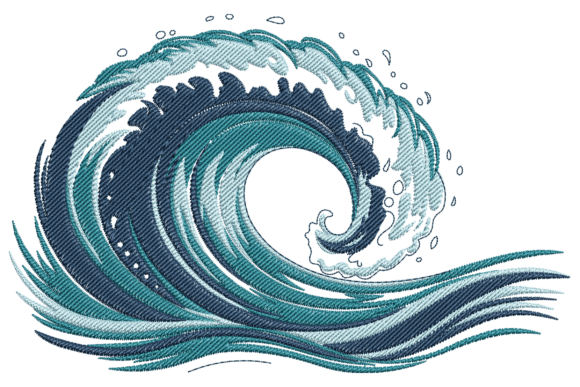
Ocean Wave: A Designer’s Real-World Review
First Impressions: Playful, Fluid, and Surprisingly Versatile
As someone who stitches 30+ custom embroidery projects weekly — from boutique aprons to Etsy baby blanket sets — I opened Ocean Wave expecting a literal wave motif. What I found was more nuanced: a rhythmic, slightly stylized crest with gentle curves, subtle layering, and a lightness that avoids looking cartoonish or overly technical. It reads as “beach” without shouting it — no palm trees, no suns, no clichés. That subtlety is its strength. The design feels intentionally balanced for machine embroidery: clean satin stitch edges along the wave’s lip, soft fill stitch body, and just enough running stitch detail to suggest motion without overwhelming small hoop sizes.
Where Ocean Wave Naturally Fits (and Where It Doesn’t)
This isn’t a standalone logo or monogram replacement — it’s a decorative accent. Think of it as the quiet punctuation in your product story. In my studio, Ocean Wave landed immediately on three real items: a linen kitchen towel (lower corner), a navy cotton tote bag (centered on the front panel), and a lightweight organic-cotton baby blanket (top-left corner, scaled down 15%). All three worked because the design’s flow complements fabric drape and scale without demanding center-stage attention.
It shines on medium-weight woven fabrics — towels, totes, pillow covers, aprons, sweatshirt backs — where stitch definition holds. On stretchy knits like t-shirts? Proceed with caution: test thoroughly. The wave’s gentle curves can distort if stabilizer choice or hooping tension isn’t dialed in. For caps, I’d reserve Ocean Wave for the front panel only — avoid curved bill areas unless you’re using a cap frame and have confirmed the file’s stitch density allows clean travel over seams.
Performance Across Common Handmade Products
- Tote bag design: Excellent. Its horizontal emphasis anchors the canvas without crowding handles. Looks especially polished when stitched in tonal blues or seafoam thread on natural canvas.
- Sweatshirt embroidery: Works well on solid-color fleece or French terry — but avoid dense black or charcoal unless you’ve tested thread contrast. A matte navy thread on heather grey reads beautifully.
- Baby items & nursery decor: Gentle enough for blankets, burp cloths, and crib mobiles. No sharp points or tiny detached elements — a plus for safety-conscious buyers.
- Kitchen towels & aprons: Practical and charming. The wave’s implied movement pairs naturally with culinary themes — think coastal cafes or seaside boutiques.
- Embroidered patch: Possible, but check the original file’s smallest details first. If the design includes fine interior lines or tight curves, those may not translate cleanly when cut and fused.
- Personalized gift: Highly effective when paired with a name or date (e.g., “Summer ’24” beneath the wave). Adds narrative without competing visually.
What You’ll Want to Check Before Stitching
Ocean Wave is a Creative Fabrica embroidery file — meaning it’s optimized for digital machines, but not automatically foolproof. Here’s what I verified before stitching for a client:
- Hoop size: Confirmed compatibility with my 5x7” hoop (most common for small-batch makers). If you work with mini hoops (4x4”), double-check the file’s smallest version — some beach-themed designs include multiple sizes; others don’t.
- Stitch density: Reviewed the fill areas visually in my embroidery software. No excessive overlapping or nested fills — a good sign for wash durability and fabric breathability.
- Thread colors: Tested two palettes: classic coastal (navy, sand, seafoam) and unexpected (terracotta, oat, slate). The latter surprised me — the wave held its shape and mood beautifully, proving its adaptability beyond expected colorways.
- Stabilizer match: Used medium-weight tear-away for towels and totes, cut-away for knits. On dark fabric, added a layer of white topping to prevent shadowing in satin-stitched edges.
- File details & license: Scrolled carefully through the Creative Fabrica product page. Verified this is a commercial-use embroidery file — essential if you’re selling finished products on Etsy or at craft fairs. Also noted whether it included applique design variants (it didn’t — pure machine embroidery design).
How Ocean Wave Elevates Your Handmade Product
It’s easy to underestimate how much a single, well-chosen digital embroidery file impacts buyer perception. Ocean Wave adds quiet sophistication — not flash, but intention. When photographed on a linen pillow cover beside a seashell and dried lavender, it reads as curated, not mass-produced. That translates directly to higher perceived value and stronger customer trust, especially among shoppers seeking handmade authenticity.
For Etsy sellers, it’s a smart design asset: beach-themed listings convert well in spring/summer, and Ocean Wave fits seamlessly into collections (think matching towel + apron + baby blanket sets). Its flexibility means one download supports multiple SKUs — reducing design overhead without sacrificing uniqueness.
And for creative entrepreneurs building a brand? Consistency matters. Using Ocean Wave across product categories — say, on your shop banner mockup, packaging tags, and physical goods — creates visual cohesion. It becomes part of your signature language, not just decoration.
A Few Honest Notes for Real-World Use
Because I used Ocean Wave for an actual baby blanket order, here’s what stood out: the stitch-out was clean on first run — no thread breaks or jump stitches — but the smallest curve near the wave’s tip needed re-hooping on a second pass for crispness on textured organic cotton. Also, while the design avoids tiny lettering (a relief), always inspect the final stitched piece under natural light: sometimes subtle fill shifts aren’t visible on screen but affect texture on dark fabric.
If you’re new to beach-themed embroidery or building a seasonal collection, Ocean Wave is a grounded, repeatable choice. It won’t dominate your garment — it’ll complement it. And in a market saturated with overdesigned motifs, that restraint is rare — and valuable.