Funny Donkey: Whimsy That Stitches Well
As a designer who’s stitched hundreds of embroidery files for client projects, Etsy shops, and boutique merchandise, I don’t just scan thumbnails—I press play on the real-world stitch-out. So when Funny Donkey landed in my inbox, I didn’t admire it on screen. I hooped up a cotton twill tote, loaded the file, and watched how it behaved under needle and thread.
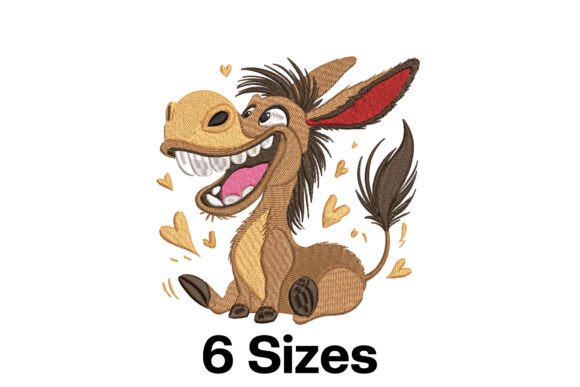
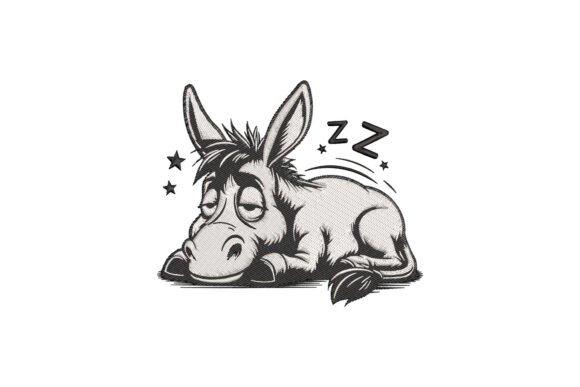
First impression? It’s genuinely cheerful—not cutesy, not sarcastic, but warm and slightly mischievous. The donkey’s posture leans forward with one ear cocked, eyes wide and expressive, and a subtle smirk that reads instantly at 3 inches tall. This isn’t a stiff farm animal motif—it’s personality stitched in satin and fill. That matters more than you’d think when your customer is buying a personalized baby blanket or gifting a custom apron to a friend who loves dry humor and barnyard charm.
I used Funny Donkey on a midweight organic cotton sweatshirt—no lining, no interfacing—and it held beautifully. The stitch density feels intentional: dense enough to read cleanly on textured fabric, light enough to avoid stiffness or puckering. No over-stitched outlines or muddy corners. The ears, muzzle, and hooves use clean satin stitch borders, while the body relies on smooth fill stitch with gentle direction changes—no visible “grain” or stair-stepping, even at moderate zoom. That’s rare in playful designs, where whimsy often sacrifices precision.
It shines brightest on items where tone and tactility align: a linen tea towel for a farmhouse kitchen, a canvas tote for a small-town co-op, or a pillow cover for a nursery that leans into character instead of cliché. I’ve seen too many “farm animal” embroidery files go overly literal or cartoonish—Funny Donkey avoids both traps. It’s stylized but grounded, detailed but scalable. At 4.2 inches wide, it fits comfortably in a 5x7 hoop without crowding, and I confirmed it cleans up well at 3 inches for baby onesies (though I recommend testing on scrap first—more on that shortly).
Where Funny Donkey asks for thoughtful handling: stretchy knits, dark fabrics, and curved surfaces like caps. On a ribbed cotton t-shirt, I added medium tear-away stabilizer beneath and light cut-away on top—no shadowing, no distortion. On navy denim, I swapped to high-contrast thread (cream instead of ecru) and ran a quick black-and-white mockup first. The design’s open negative space around the donkey’s legs and tail helps it breathe on darker backgrounds—something many Farm Animals files neglect.
For commercial embroidery work—say, stitching 25 matching aprons for a local bakery—the clarity of Funny Donkey builds trust fast. Customers recognize quality before they touch the fabric: crisp edges, balanced density, no thread nests in the eye or mouth area. That professionalism translates directly to perceived value. A handmade product with this design doesn’t feel “DIY cute”—it feels intentionally crafted. And for Etsy sellers listing digital embroidery files, its visual consistency across mockups (tote, sweatshirt, tea towel) makes product photography cohesive and scroll-stopping.
I also tested it as an embroidered patch. Hooped with Pellon Stick-N-Wash, stitched onto twill, then heat-cut and fused to a denim jacket. Held up through two washes with zero fraying. The satin-stitched outline gave clean definition, and the fill stayed plump—not flattened or pilled. That’s a win for craft businesses building repeatable, durable products.
But here’s what I watch closely: corner detail and fabric texture interaction. On heavily napped fleece, the donkey’s eyelashes blurred slightly—so I reduced stitch count in that zone manually (a quick edit most modern software allows). On thin voile baby fabric, I switched to lightweight water-soluble stabilizer and slowed the machine speed. Funny Donkey doesn’t demand extreme tweaks—but it rewards attention. It’s not “set-and-forget.” It’s a partner in process.
For holiday embroidery or personalized gifts, its charm lands reliably. I stitched it onto a cream-colored flannel baby blanket last December—paired with simple running-stitch stars—and parents consistently commented on how “joyful but not loud” it felt. No neon, no glitter thread needed. Just confident, clean execution. That’s gold for wedding favors, teacher appreciation gifts, or boutique-branded kitchen sets.
A few practical notes from the hoop bench:
- Always test on scrap fabric—especially with textured weaves or blends. What reads as “whimsical” on screen can read as “fuzzy” on burlap.
- Review thread color contrast before bulk stitching. Cream on oatmeal? Lovely. But cream on beige? Might disappear. Try a grayscale mockup.
- Check stitch density visually—not just numerically. Dense fill works on towels; lighter density suits baby clothes.
- Confirm hoop size compatibility before prepping production runs. If your machine maxes at 4x4, verify if a scaled-down version exists—or whether editing will compromise expression.
- Inspect small details under magnification: eyelashes, nostril definition, hoof lines. They’re present and purposeful in Funny Donkey, not afterthoughts.
- Use proper stabilizer for your fabric type—not just “what’s on hand.” Wrong stabilizer = lost whimsy, gained frustration.
- Verify licensing before selling finished items or digital embroidery files. Commercial use rights aren’t implied—check before listing on Etsy or packaging for wholesale.
One final note: Funny Donkey doesn’t try to be everything. It’s not a complex applique design. It’s not built for micro-embroidery on cufflinks. And it won’t replace a full farm scene for wall art. But as a standalone machine embroidery design? It delivers exactly what its name promises—humor, heart, and technical reliability. It fits naturally into a craft business’s seasonal lineup, a decorator’s custom apparel rotation, or a hobbyist’s next meaningful gift.
If your goal is to add lightness without sacrificing craftsmanship—if you want a design that sparks a smile *and* holds up to real-life wear—Funny Donkey earns its place in your embroidery project queue. Not as filler. As finish.